Nahdlatul Ulama and Digital Civil Society in the Post-Truth Era: Contesting Moderate Islamic Narratives on Social Media
DOI:
https://doi.org/10.35672/jnus.v7i1.45-64Keywords:
Digital Civil Society, Framing Contestation, Nahdlatul Ulama, Post-Truth, Religious ModerationAbstract
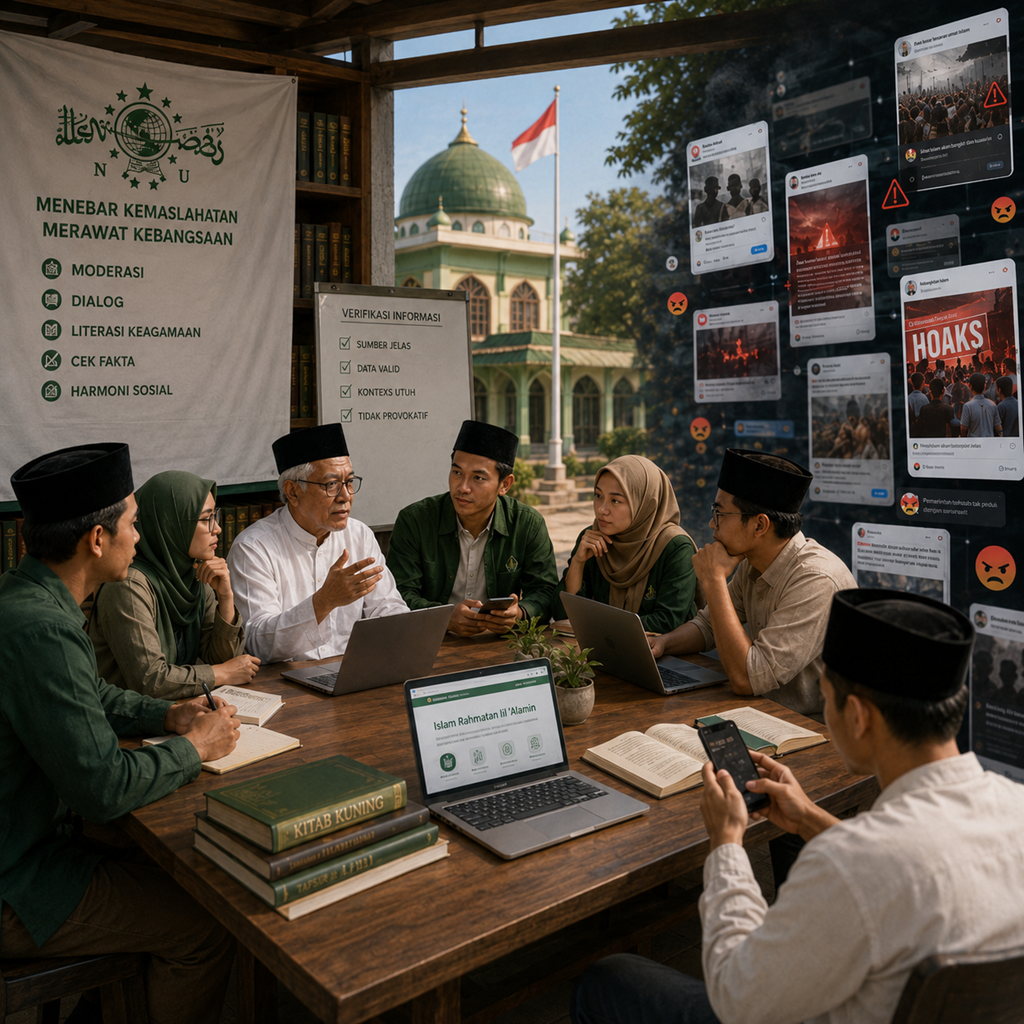
This article examines the framing contestation surrounding Nahdlatul Ulama (NU) within Indonesia’s post-truth digital environment. Employing framing theory, information disorder frameworks, and communication power theory, this study analyzes how NU is represented, contested, and negotiated across social media platforms. Through qualitative document analysis and systematic literature review, three dominant competing frames are identified: the moderate-nationalist frame promoted by NU’s official digital ecosystem, the radical-opposition frame constructed by conservative Islamist networks, and the populist-identity frame deployed by political actors for electoral mobilization. The study finds that post-truth conditions, algorithmic amplification, and networked disinformation campaigns create structurally asymmetric conditions that disadvantage NU’s moderate Islamic narratives. In response, NU has developed multifaceted counter-narrative strategies encompassing institutional digital platforms such as NU Online, media literacy programs within pesantren communities, creative da‘wa content production, and collaborative regulatory engagement with state institutions. The article argues that NU increasingly functions as a significant digital civil society actor whose communication strategies contribute to the preservation of democratic discourse and religious moderation in Indonesia. These findings offer broader insights into how large-scale Islamic organizations navigate digitally mediated information disorders while maintaining commitments to democratic pluralism and social cohesion.
References
Abadi, M., Arraki, R., Shukyzhanova, A., & Khan, K. A. (2023). Analysis of paradigm shift toward the transformation of Nahdlatul Ulama’s political orientation. Analisa: Journal of Social Science and Religion, 8(1), 1–18. https://doi.org/10.18784/analisa.v8i1.1950
Abrori, Pimay, A., & Amin, N. (2026). Digital da’wah strategies in the era of social media and digital platforms: Opportunities, challenges, and effective practices. DAWUH: Islamic Communication Journal, 7(2), 37–48. https://doi.org/10.62159/dawuh.v7i2.1919
Ahdar. (2026). Dakwah modern: Media, metode, dan masa depan umat (Musyarif, Ed.). IAIN Parepare Nusantara Press.
Aida, B., Supena, I., & Sulthon, M. (2024). The latest religious practices of da’i influencer and content creator in digital da’wah. Jurnal Ilmu Dakwah, 44(2), 427–456. https://doi.org/10.21580/jid.v44.2.23378
Andhara, A. N., Ulandari, S., Fikri, F., Fahmi, A., Syauqi, Q. A., Suryadayana, A., & Sabila, A. (2025). Hoaks tentang pesantren di media sosial dan upaya menangkalnya. ISME: Journal of Islamic Studies and Multidisciplinary Research, 3(2), 164–172. https://doi.org/10.61683/isme.vol32.2025.164-172
Aziz, H., & Fahruddin. (2021). Modernisasi media massa Nahdlatul Ulama. Karmawibangga Historical Studies Journal, 3(2), 101–112. https://doi.org/10.31316/fkip.v3i2.2136
Benkler, Y., Faris, R., & Roberts, H. (2018). Network propaganda: Manipulation, disinformation, and radicalization in American politics. Oxford University Press. https://doi.org/10.1093/oso/9780190923624.001.0001
Berenschot, W., & Wijayanto. (2024). Cybertroops and public opinion manipulation through social media in Indonesia. Centre for Strategic and International Studies. https://www.csis.or.id/publication/cybertroops-and-public-opinion-manipulation-through-social-media-in-indonesia-cybertroops-and-public-opinion-manipulation-through-social-media-in-indonesia/
Budarick, J. (2019). Ethnic media and democracy: From liberalism to agonism. Palgrave Macmillan. https://doi.org/10.1007/978-3-030-16492-8
Couldry, N., & Hepp, A. (2018). The continuing lure of the mediated centre in times of deep mediatization: “Media events” and its enduring legacy. Media, Culture & Society, 40(1), 114–117. https://doi.org/10.1177/0163443717726009
Fajriyah, N., Rahman, K., & Syarif, Z. (2026). Tradition-based Islamic renewal: An analysis of Nahdlatul Ulama’s thought in the context of religious moderation. Al-Afkar, Journal for Islamic Studies, 9(2), 1478–1499. https://doi.org/10.31943/afkarjournal.v9i2.3067
Hardoš, P. (2019). [Review of the book Post-truth, by L. McIntyre]. Organon F, 26(2), 311–316. https://doi.org/10.31577/orgf.2019.26210
Ja’far, A. (2019). Literasi digital pesantren: Perubahan dan kontestasi. Islamic Review: Jurnal Riset dan Kajian Keislaman, 8(1), 17–35. https://doi.org/10.35878/islamicreview.v8i1.156
Jurriëns, E. (2020). [Review of the book Media power in Indonesia: Oligarchs, citizens and the digital revolution, by R. Tapsell]. Archipel, 100, 254–256. https://doi.org/10.4000/archipel.2278
Kementerian Komunikasi dan Digital Republik Indonesia. (2025, January 8). Komdigi identifikasi 1.923 konten hoaks sepanjang tahun 2024. https://www.komdigi.go.id/berita/siaranpers/detail/komdigi-identifikasi-1923-konten-hoaks-sepanjang-tahun-2024
Khoria, N. A. (2021). Manajemen pengorganisasian dakwah: Strategi Lembaga Dakwah MWC NU Kaliwungu dalam mengatasi tantangan globalisasi. Journal of Islamic Management, 1(2), 109–123. https://doi.org/10.15642/jim.v1i2.554
Kurniati, P., Putra, H. M., Komara, L. S., Wibianika, H., & Setiansyah, R. (2021). Budaya kewarganegaraan, praktik kewarganegaraan, dan pendidikan untuk kewarganegaraan demokratis. Jurnal Ilmiah P2M STKIP Siliwangi, 8(2), 107–115. https://doi.org/10.22460/p2m.v8i2p107-115.2852
Kuś, J. (2026). Medical disinformation in the social media environment. In W. Kulesza, D. Doliński, & T. Grzyb (Eds.), Vaccines and vaccinations: A psychological perspective: Research and recommendations (pp. 223–232). Springer. https://doi.org/10.1007/978-3-032-18151-0_13
Kuswana, D. (2024). Digital counter-radicalism: The strategic role of religious organisations in shaping moderate Islam in Indonesia’s cyber realm. Khazanah Theologia, 6(1), 45–60. https://doi.org/10.15575/kt.v6i1.33369
Lim, M. (2017). Freedom to hate: Social media, algorithmic enclaves, and the rise of tribal nationalism in Indonesia. Critical Asian Studies, 49(3), 411–427. https://doi.org/10.1080/14672715.2017.1341188
Maharani, M. D. (2025). Salafism in Indonesia: Ideology, identity, and politics. Islamic Thought Review, 3(1), 1–13. https://doi.org/10.30983/itr.v3i1.9352
McIntyre, L. (2018). Post-truth. MIT Press.
Mietzner, M., & Muhtadi, B. (2018). Explaining the 2016 Islamist mobilisation in Indonesia: Religious intolerance, militant groups, and the politics of accommodation. Asian Studies Review, 42(3), 479–497. https://doi.org/10.1080/10357823.2018.1473335
Nisa, E. F. (2018). Creative and lucrative da‘wa: The visual culture of Instagram amongst female Muslim youth in Indonesia. Asiascape: Digital Asia, 5(1–2), 68–89. https://doi.org/10.1163/22142312-12340085
Novita, I., Nur, I., & Rose, T. (2021). Konstruksi realitas media: Analisis framing pemberitaan UU Cipta Kerja Omnibus Law dalam media online Vivanews dan Tirto.id. Jurnal Health Sains, 2(1), 69–84. https://doi.org/10.46799/jsa.v2i1.162
Postill, J. (2017). The diachronic ethnography of media: From social changing to actual social changes. Moment Dergi, 4(1), 19–43. https://doi.org/10.17572/mj2017.1.1943
Rakhmani, I. (2017). Mainstreaming Islam in Indonesia: Television, identity, and the middle class. Palgrave Macmillan. https://doi.org/10.1057/978-1-137-54880-1
Rofi’i, M. A., & Zahroh, S. F. (2024). Peran Nahdlatul Ulama dalam menjaga keharmonisan umat beragama di era disrupsi digital. NAHNU: Journal of Nahdlatul Ulama and Contemporary Islamic Studies, 2(2), 339–368. https://doi.org/10.63875/nahnu.v2i2.44
Salim, D. P. (2022). The Islamic political supports and voting behaviors in majority and minority Muslim provinces in Indonesia. Indonesian Journal of Islam and Muslim Societies, 12(1), 85–110. https://doi.org/10.18326/ijims.v12i1.85-110
Sułkowski, Ł., Lehman, I., & Szczepańska-Woszczyna, K. (2026). Qualitative methods in digital inquiry. Routledge. https://doi.org/10.4324/9781003790310
Syafitrah, A. (2023, December 15). Hoaks di Indonesia tahun 2022. MAFINDO. https://mafindo.or.id/publikasi-riset/laporan/laporan-tahunan/hoaks-di-indonesia-tahun-2022/
Tapsell, R. (2021). Social media and elections in Southeast Asia: The emergence of subversive, underground campaigning. Asian Studies Review, 45(1), 117–134. https://doi.org/10.1080/10357823.2020.1841093
Tohari, A. (2024). Respon masyarakat pedesaan terhadap digitalisasi di kalangan Nahdlatul Ulama. NAHNU: Journal of Nahdlatul Ulama and Contemporary Islamic Studies, 2(2), 369–384. https://doi.org/10.63875/nahnu.v2i2.45
Wahid Foundation. (2023, October 5). Laporan kemerdekaan beragama dan berkeyakinan di Indonesia tahun 2020–2022. https://wahidfoundation.org/news/detail/Wahid-Foundation-Diskusikan-Laporan-Kemerdekaan-Beragama-dan-Berkeyakinan-di-Indonesia-Tahun-2020-2022
Zhang, J. (2025). Information disorder, media literacy, and the crisis of trust in knowledge institutions. Scholedge International Journal of Multidisciplinary & Allied Studies, 12(4), 28–36. https://doi.org/10.19085/sijmas120401
Downloads
Published
How to Cite
Issue
Section
License
Copyright (c) 2026 Deryl Ardica, Muhammad Syaf'ul Iktafi, Agus Nurwansyah

This work is licensed under a Creative Commons Attribution-ShareAlike 4.0 International License.




.png)


