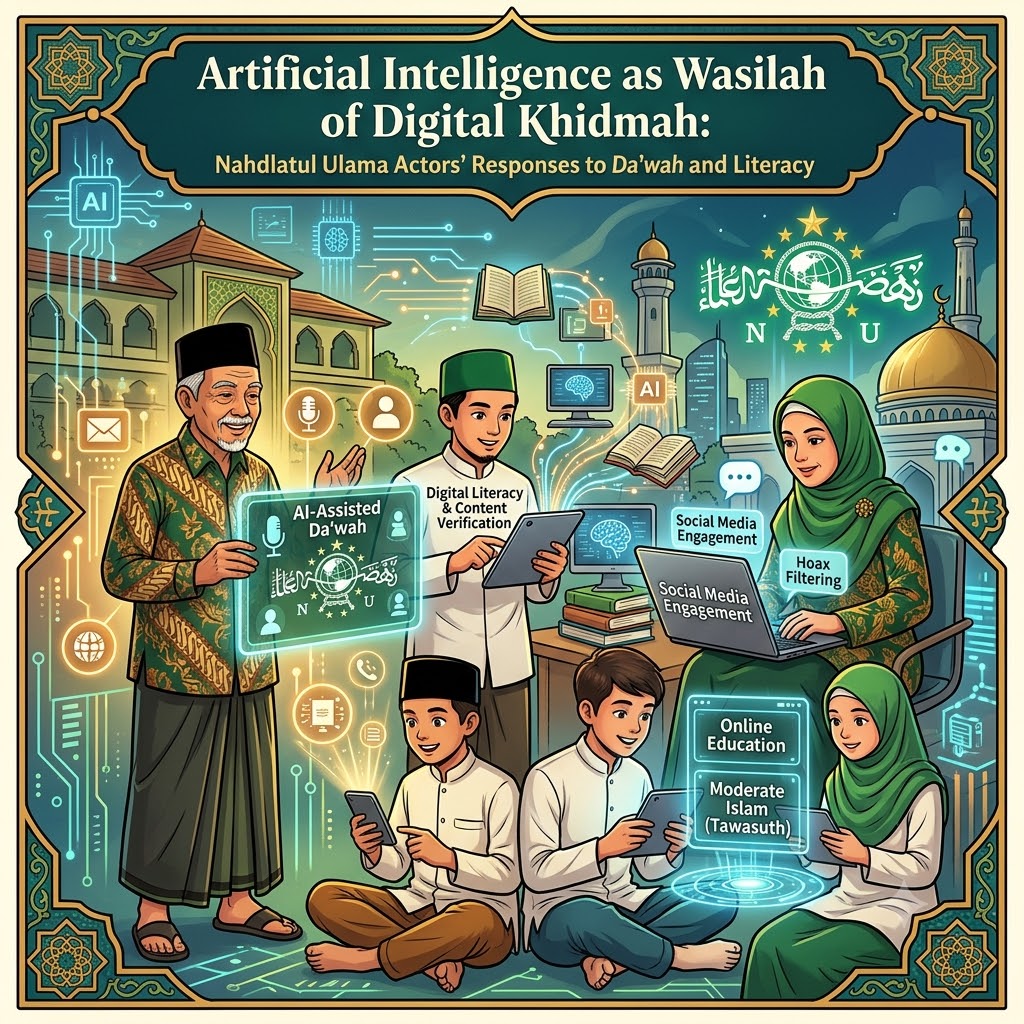
Artificial Intelligence as Wasilah of Digital Khidmah: Nahdlatul Ulama Actors' Responses to Da'wah and Literacy
DOI:
https://doi.org/10.35672/jnus.v7i1.97-115Keywords:
Artificial Intelligence, Nahdlatul Ulama, Digital Khidmah, Scholarly Sanad, Digital Da'wahAbstract
The rapid development of Artificial Intelligence (AI), especially generative AI and large language models (LLMs), has transformed the ways people search for, produce, and circulate religious knowledge. In the context of Nahdlatul Ulama (NU), AI offers opportunities for strengthening digital da'wah, religious literacy, and organizational services, yet it also raises serious questions about epistemic validity, religious authority, and the continuity of sanad in Islamic learning. This article analyzes how NU actors respond to AI in relation to da'wah, religious literacy, and digital khidmah. It employs a descriptive qualitative and exploratory approach based on literature review, digital observation, and limited interviews with NU actors concerned with media and digital transformation. The data were analyzed thematically by focusing on three issues: AI as a tool for digital service, the epistemic risks of AI-generated religious answers, and the ethical importance of sanad, tabayyun, and human authority. The article argues that AI should be positioned as a wasilah for digital khidmah, rather than a substitute for ulama, kiai, pesantren, or bahtsul masail. Its contribution lies in formulating an NU-based ethical reading of AI that combines technological adaptation with the preservation of religious knowledge, scholarly authority, source credibility, and pesantren-based ethics.
References
Akmaliah, W. (2020). The demise of moderate Islam: New media, contestation, and reclaiming religious authorities. Indonesian Journal of Islam and Muslim Societies, 10(1), 1-24. https://doi.org/10.18326/ijims.v10i1.1-24
Akmaliah, W. (2022). Reclaiming moderate Islam in Nahdlatul Ulama: Challenging the dominant religious authority in digital platform. Journal of Indonesian Islam, 16(1), 223-248. https://doi.org/10.15642/JIIS.2022.16.1.223-248
Ali, H. (2026). Personal interview in Jakarta/offline, 26 May 2026.
Bender, E. M., Gebru, T., McMillan-Major, A., & Shmitchell, S. (2021). On the dangers of stochastic parrots: Can language models be too big? In Proceedings of the 2021 ACM Conference on Fairness, Accountability, and Transparency (pp. 610-623). Association for Computing Machinery. https://doi.org/10.1145/3442188.3445922
Braun, V., & Clarke, V. (2006). Using thematic analysis in psychology. Qualitative Research in Psychology, 3(2), 77-101. https://doi.org/10.1191/1478088706qp063oa
Braun, V., & Clarke, V. (2022). Toward good practice in thematic analysis: Avoiding common problems and be(com)ing a knowing researcher. International Journal of Transgender Health, 24(1), 1-6. https://doi.org/10.1080/26895269.2022.2129597
Bush, R., & Fealy, G. (2014). The political decline of traditional ulama in Indonesia: The state, umma and Nahdlatul Ulama. Asian Journal of Social Science, 42(5), 536-560. https://doi.org/10.1163/15685314-04205004
Campbell, H. A. (2012). Digital religion: Understanding religious practice in new media worlds. Routledge.
Campbell, H. A., & Evolvi, G. (2020). Contextualizing current digital religion research on emerging technologies. Human Behavior and Emerging Technologies, 2(1), 5-17. https://doi.org/10.1002/hbe2.149
Cheong, P. H. (2017). The vitality of new media and religion: Communicative perspectives, practices, and changing authority in spiritual organization. New Media & Society, 19(1), 25-33. https://doi.org/10.1177/1461444816649913
Couldry, N., & Mejias, U. A. (2019). Data colonialism: Rethinking big data's relation to the contemporary subject. Television & New Media, 20(4), 336-349. https://doi.org/10.1177/1527476418796632
Creswell, J. W., & Poth, C. N. (2018). Qualitative inquiry and research design: Choosing among five approaches (4th ed.). SAGE Publications.
Digdaya NU. (2026). Bukan pengganti ulama: Mengenal Digdaya AI-NU, asisten baru pengurus NU [Online]. Available at: https://digdaya.nu.id/artikel/ai-bukan-ancaman-ini-asisten-baru-pengurus-nu (Accessed: 19 June 2026).
Elmahjub, E. (2023). Artificial Intelligence (AI) in Islamic ethics: Towards pluralist ethical benchmarking for AI. Philosophy & Technology, 36, Article 73. https://doi.org/10.1007/s13347-023-00668-x
Floridi, L., & Cowls, J. (2019). A unified framework of five principles for AI in society. Harvard Data Science Review, 1(1), 1-15. https://doi.org/10.1162/99608f92.8cd550d1
Hannan, A., & Mursyidi, A. F. (2023). Social media and the fragmentation of religious authority among Muslims in contemporary Indonesia. Digital Muslim Review, 1(2), 84-104. https://doi.org/10.32678/dmr.v1i2.10
Hine, C. (2015). Ethnography for the Internet: Embedded, embodied and everyday. Bloomsbury Academic.
Hjarvard, S. (2011). The mediatisation of religion: Theorising religion, media and social change. Culture and Religion, 12(2), 119-135. https://doi.org/10.1080/14755610.2011.579719
Huang, L., Yu, W., Ma, W., Zhong, W., Feng, Z., Wang, H., Chen, Q., Peng, W., Feng, X., Qin, B., & Liu, T. (2025). A survey on hallucination in large language models: Principles, taxonomy, challenges, and open questions. ACM Transactions on Information Systems, 43(2), Article 42. https://doi.org/10.1145/3703155
Ji, Z., Lee, N., Frieske, R., Yu, T., Su, D., Xu, Y., Ishii, E., Bang, Y. J., Chen, D., Dai, W., Chan, H. S., Madotto, A., & Fung, P. (2023). Survey of hallucination in natural language generation. ACM Computing Surveys, 55(12), Article 248. https://doi.org/10.1145/3571730
Jobin, A., Ienca, M., & Vayena, E. (2019). The global landscape of AI ethics guidelines. Nature Machine Intelligence, 1, 389-399. https://doi.org/10.1038/s42256-019-0088-2
Kozinets, R. V. (2015). Netnography: Redefined (2nd ed.). SAGE Publications.
Lincoln, Y. S., & Guba, E. G. (1985). Naturalistic inquiry. SAGE Publications.
Mittelstadt, B. D., Allo, P., Taddeo, M., Wachter, S., & Floridi, L. (2016). The ethics of algorithms: Mapping the debate. Big Data & Society, 3(2), 1-21. https://doi.org/10.1177/2053951716679679
Muhammad Syakir NF. (2023a). Munas NU 2023: Bertanya ke AI boleh, tapi haram dijadikan pedoman untuk diamalkan [Online]. Available at: https://nu.or.id/nasional/munas-nu-2023-bertanya-ke-ai-boleh-tapi-haram-dijadikan-pedoman-untuk-diamalkan-HvEJ3 (Accessed: 19 June 2026).
Muhammad Syakir NF. (2023b). Munas NU 2023 rekomendasikan PBNU bikin AI [Online]. Available at: https://www.nu.or.id/nasional/munas-nu-2023-rekomendasikan-pbnu-bikin-ai-mluw3 (Accessed: 19 June 2026).
Mufidah Adzkia. (2025). Alvara: NU Online sumber kredibel di era AI dan banjir informasi [Online]. Available at: https://nu.or.id/nasional/alvara-nu-online-sumber-kredibel-di-era-ai-dan-banjir-informasi-khtqe (Accessed: 19 June 2026).
NU Online. (2025). Savic Ali ungkap peluang dan tantangan AI dalam tradisi keilmuan [Online]. Available at: https://www.nu.or.id/jateng/savic-ali-ungkap-peluang-dan-tantangan-ai-dalam-tradisi-keilmuan-aseLx (Accessed: 19 June 2026).
Nowell, L. S., Norris, J. M., White, D. E., & Moules, N. J. (2017). Thematic analysis: Striving to meet the trustworthiness criteria. International Journal of Qualitative Methods, 16(1), 1-13. https://doi.org/10.1177/1609406917733847
Patton, M. Q. (2015). Qualitative research and evaluation methods (4th ed.). SAGE Publications.
Reed, R. (2021). The theology of GPT-2: Religion and artificial intelligence. Religion Compass, 15(11), e12422. https://doi.org/10.1111/rec3.12422
Salendra, I. W. (2024). Religious moderation in digital media discourse: A study of the nu.or.id portal from the perspective of communicative rationality. Fikri: Jurnal Kajian Agama, Sosial dan Budaya, 9(2), 200-220. https://doi.org/10.25217/jf.v9i2.4954
Setia, P., & Iqbal, A. M. (2021). Adaptasi media sosial oleh organisasi keagamaan di Indonesia: Studi kanal YouTube Nahdlatul Ulama, NU Channel. JISPO Jurnal Ilmu Sosial dan Ilmu Politik, 11(2), 359-378. https://doi.org/10.15575/jispo.v11i2.14572
Solahudin, D., & Fakhruroji, M. (2020). Internet and Islamic learning practices in Indonesia: Social media, religious populism, and religious authority. Religions, 11(1), Article 19. https://doi.org/10.3390/rel11010019
Stahl, B. C., & Wright, D. (2018). Ethics and privacy in AI and big data: Implementing responsible research and innovation. IEEE Security & Privacy, 16(3), 26-33. https://doi.org/10.1109/MSP.2018.2701164
Suherdiana, D., & Muhaemin, E. (2018). The da'wah of Nahdlatul Ulama and Muhammadiyah in social media of Facebook. Ilmu Dakwah: Academic Journal for Homiletic Studies, 12(2), 187-200. https://doi.org/10.15575/idajhs.v12i2.6176
Sunnatullah. (2026). Hukum tanya agama ke AI: Bedah putusan Munas NU 2023 tentang kecerdasan buatan [Online]. Available at: https://islam.nu.or.id/syariah/hukum-tanya-agama-ke-ai-bedah-putusan-munas-nu-2023-tentang-kecerdasan-buatan-e437c (Accessed: 19 June 2026).
Trepczynski, M. (2023). Religion, theology, and philosophical skills of LLM-powered chatbots. Disputatio Philosophica, 25(1), 9-33. https://doi.org/10.32701/dp.25.1.2
Tsuria, R., Yadlin-Segal, A., & Vitullo, A. (2024). Artificial Intelligence's understanding of religion: Investigating the moralistic approaches presented by generative artificial intelligence tools. Religions, 15(3), Article 375. https://doi.org/10.3390/rel15030375
Zhang, J., Song, W., & Liu, Y. (2025). Cognitive bias in generative AI influences religious education. Scientific Reports, 15, Article 15720. https://doi.org/10.1038/s41598-025-99121-
Downloads
Published
How to Cite
Issue
Section
License
Copyright (c) 2026 Wahyu Khoiruzzaman, Ilmi Hidayati

This work is licensed under a Creative Commons Attribution-ShareAlike 4.0 International License.




.png)


