The Effect of Motivation and Job Satisfaction on Employee Performance at the Halal Product Assurance Agency (BPJPH) Jakarta Based on Aswaja Nahdlatul Ulama Values
DOI:
https://doi.org/10.35672/jnus.v7i1.15-29Keywords:
Work Motivation, Job Satisfaction, Employee Performance, Aswaja Nahdlatul Ulama, BPJPHAbstract
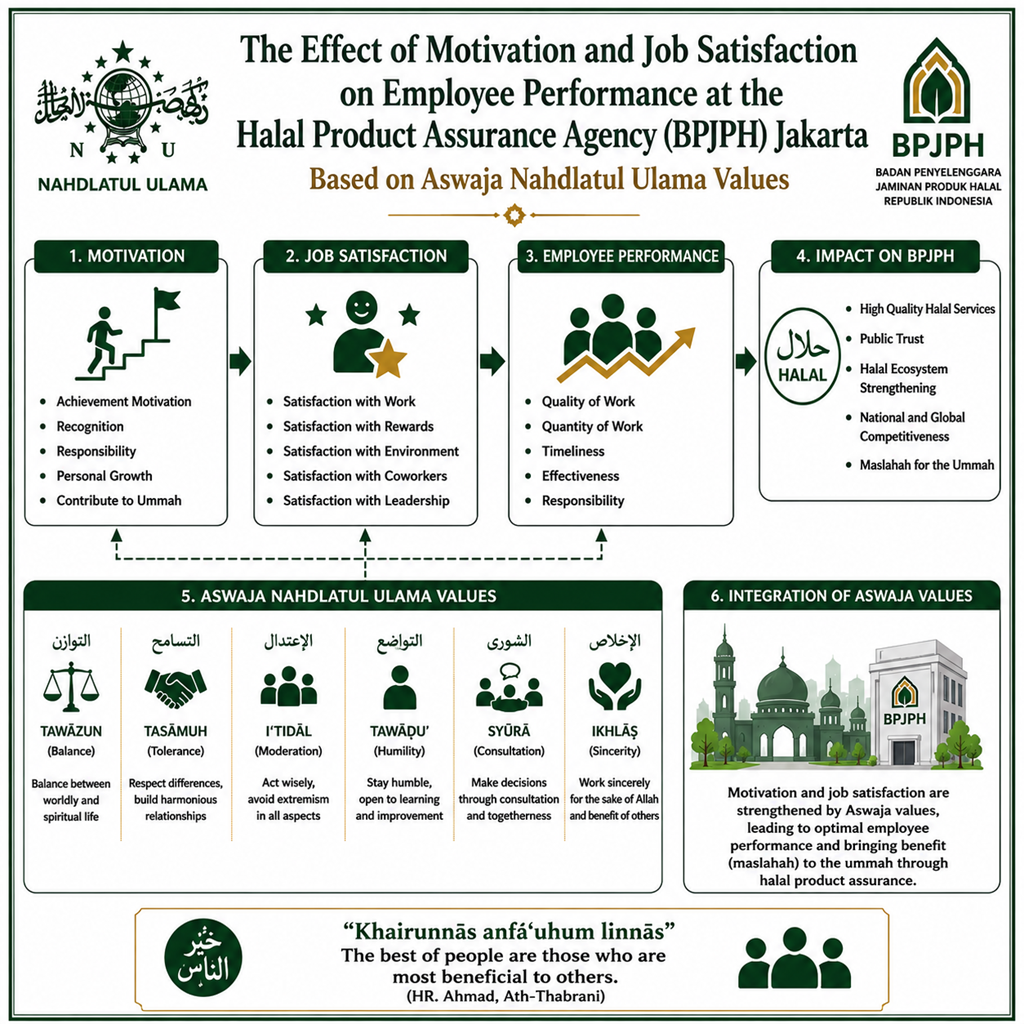
This study is grounded in the importance of human resource development in improving employee performance within public service institutions, particularly the Halal Product Assurance Agency (BPJPH) Jakarta. Employee performance is not only influenced by managerial aspects such as motivation and job satisfaction but also by ethical values that shape organizational work culture. Therefore, this study aims to examine the partial effect of motivation on employee performance, the partial effect of job satisfaction on employee performance, the simultaneous effect of motivation and job satisfaction on employee performance, and to assess the extent to which work patterns at BPJPH align with the values of Ahlussunnah wal Jama’ah (Aswaja) of Nahdlatul Ulama. This research employs a quantitative approach with a field research design. The population consists of 205 BPJPH employees, with a sample of 70 respondents selected using a convenience sampling technique. Data were collected through questionnaires, observations, and interviews, and analyzed using descriptive statistics and multiple linear regression with the assistance of IBM SPSS Statistics. The findings reveal that motivation has a positive but not significant partial effect on employee performance, while job satisfaction has no positive and significant partial effect. However, motivation and job satisfaction simultaneously have a significant effect on employee performance. Furthermore, the work patterns at BPJPH generally reflect Aswaja values tawassuth (moderation), tasamuh (tolerance), tawazun (balance), and i’tidal (justice) although improvements are still needed in incentives, career development, and recognition systems. This study contributes to the development of value-based human resource management, particularly in integrating Islamic values into professional work ethics within public service institutions.
References
Ado, S., Salama, M. A., & Abdallah, A. S. (2025). The Maqasid al-Shari’ah and the Protection of Family Economics in Islamic Law: A Reflection on Surah al-Baqarah 2: 188. QURU’: Journal of Family Law and Culture, 3(3), 264–282. https://doi.org/https://doi.org/10.59698/quru.v3i3.477
Arianty, N. (2014). Pengaruh budaya organisasi terhadap kinerja pegawai. Jurnal Ilmiah Manajemen Dan Bisnis, 14(2).
Asmike, M., & Sari, P. O. (2022). Manajemen Kinerja “Meningkatkan Keunggulan Bersaing.” Unipma Press.
Auda, J. (2015). Membumikan Hukum Islam Melalui Maqasid Syariah, terj. Rosidin Dan Ali Abd El-Mun’im. Bandung: Mizan.
Bagis, F., Pratama, B. C., & Kharismasyah, A. Y. (2019). Pengaruh disiplin kerja, komitmen organisasi dan kepuasan kerja terhadap kinerja karyawan studi kasus institusi pendidikan. DERIVATIF: Jurnal Manajemen, 13(2).
Cahyono, D. D., Hamda, M. K., & Prahastiwi, E. D. (2022). Pimikiran abraham maslow tentang motivasi dalam belajar. TAJDID: Jurnal Pemikiran Keislaman Dan Kemanusiaan, 6(1), 37–48.
Ehwanudin, E., Irhamudin, I., & Wijaya, A. (2022). Relevansi konsep pendidikan aswaja anahdliyah era industry 4.0 dan society 5.0 di pendidikan tinggi islam. Berkala Ilmiah Pendidikan, 2(2), 94–104.
Elitear, F. M.-J., & Koto, A. T.-E. (2016). Penelitian Lapangan (Field Research). nd.
Fatkhullah, F. K., Canintika, A. F., Kembaren, J. S., & Hermansyah, N. A. K. (2026). Berkah ke Meja Kerja: Implementasi Nilai Aswaja dalam Profesionalisme Kantor. Jurnal Bidang Ilmu Kesehatan, 16(1), 67–75.
Gunawan, K. (2017). Motivasi kerja menurut Abraham Maslow terhadap kinerja karyawan. Jurnal Manajemen: Untuk Ilmu Ekonomi Dan Perpustakaan, 2(2).
Japar, R., Paraikkasi, I., & Muthiadin, C. (2024). Peran lembaga sertifikasi halal dalam membangun ekosistem halal: Tantangan dan peluang. International Journal Mathla’Ul Anwar of Halal Issues, 4(2), 34–44.
Kumala, D. A. R. (2022). Strategi pengembangan sumber daya manusia. Jurnal Penelitian Dan Pengembangan Sains Dan Humaniora, 6(2), 254–261.
Lubis, T. D., Ahsan, S. C., & Rapi, M. (2024). KINERJA CAMAT DALAM IMPLEMENTASI PROGRAM PEMBANGUNAN DI KECAMATAN PALU SELATAN KOTA PALU. Caraka Prabu: Jurnal Ilmu Pemerintahan, 8(1), 86–98.
Lutfiyani, L., & Ashoumi, H. (2022). Internalisasi Nilai-Nilai Moderasi Beragama Melalui Pembelajaran Aswaja Dan Implementasinya Terhadap Sikap Anti-Radikalisme Mahasiswa. Dar El-Ilmi: Jurnal Studi Keagamaan, Pendidikan Dan Humaniora, 9(2), 1–26.
Mahbubi, M., Hidayatullah, R., Jadid, M., & Hadi, A. (2021). PKM Penguatan Nilai-Nilai Aswaja bagi Siswa di MI Nurul Mun’im dalam Membentuk Karakter Ahlusunnah wal Jamaah. GUYUB: Journal of Community Engagement, 2(3), 847–860.
Mubarak, H. A. Z. (2021). Kontekstualisasi Nilai-Nilai Aswaja Dalam Berbagai Sendi Kehidupan. zakimu. com.
Mustofa, Ai., Yusuf, M., & Setiawan, D. (2021). Penerapan Nilai-Nilai Aswaja Dalam Kehidupan Sehari-Hari Pada Masyarakat Desa Badransari Punggur Lampung Tengah. Berkala Ilmiah Pendidikan, 1(3), 103–108.
Nabawi, R. (2019). Pengaruh lingkungan kerja, kepuasan kerja dan beban kerja terhadap kinerja pegawai. Maneggio: Jurnal Ilmiah Magister Manajemen, 2(2), 170–183.
Rahmania, N., & Safitri, A. N. (2023). Implementasi Nilai-Nilai Aswaja Nahdlatul Ulama dalam Pembentukan Karakter. IERA, Islamic Education and Research Academy, 4(3), 116–133.
Rohmatika, R., & Hamzah, G. (2026). Internalisasi Karakter Aswaja Dalam Membangun Lingkungan Kerja: Membangun Karakter Profesional Berbasis Aswaja. Jurnal Ilmiah Ekonomi, Manajemen, Bisnis Dan Akuntansi, 3(1), 565–571.
Sanjaya, R. A., Firlana, H., & Priyatno, M. B. (2025). Faktor motivasi kerja yang mempengaruhi produktivitas pegawai sektor publik di Indonesia. Jurnal Lentera Bisnis, 14(2), 2022–2038.
Siswanto, B. (2019). Pengaruh motivasi kerja dan disiplin kerja terhadap kinerja karyawan. Jims, 7(2), 1–10.
Syahrizal, H., & Jailani, M. S. (2023). Jenis-jenis penelitian dalam penelitian kuantitatif dan kualitatif. QOSIM: Jurnal Pendidikan Sosial & Humaniora, 1(1), 13–23.
Transformasi 2022, Ini Capaian BPJPH Hadirkan Layanan Lebih Mudah, Murah dan Cepat | Pers Rilis | Kementerian Agama RI. (n.d.). Retrieved May 1, 2026, from https://kemenag.go.id/en/pers-rilis/transformasi-2022-ini-capaian-bpjph-hadirkan-layanan-lebih-mudah-murah-dan-cepat-akj87l
Utami, H. P. (2020). Dakwah Digital Nahdlatul Ulama Dalam Memahami Nilai-Nilai Aswaja An Nahdliyyah. Mediakita, 4(2), 107–123.
Wahyudi, F. S., Setiawan, M. A., & Armina, S. H. (2023). Industri Halal: Perkembangan, Tantangan, and Regulasi di Ekonomi Islam. Innovative: Journal Of Social Science Research, 3(6), 1801–1815.
Wawancara dengan Abjan Halek, Koordinator Bagian Organisasi, Kepegawaian, dan Hukum Sekretariat BPJPH, di Jakarta, 31 Januari 2024, pukul 11.00. (n.d.).
Downloads
Published
How to Cite
Issue
Section
License
Copyright (c) 2026 Cariza Ayu Ardaneswari

This work is licensed under a Creative Commons Attribution-ShareAlike 4.0 International License.




.png)


